Thermage FLX in Cheongdam, Seoul: firming the dermis with even energy
Thermage FLX uses monopolar radiofrequency to heat the dermis evenly across a wide area, aiming to firm skin that has lost its overall elasticity. It works on a different layer from Ulthera: the collagen-rich dermis rather than the deeper SMAS. At LUNN Dermatology Clinic in Cheongdam, Seoul, board-certified dermatologist Dr. Park Hyungkwon sets the energy level for your skin and performs the treatment himself with the FLX tip. Change builds gradually over the following months, and results vary by individual.
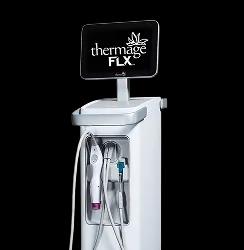
- Treatment
- Thermage FLX
- Device / product
- Thermage FLX by Solta Medical (USA), monopolar radiofrequency with the FLX tip
- Area
- Face, including the jawline and the area around the eyes
- Performed by
- Dr. Park Hyungkwon, board-certified dermatologist
- Where
- LUNN Dermatology Clinic, 5F, 822 Seolleung-ro, Cheongdam, Seoul
What kind of change is Thermage FLX designed for?
Some faces have not dropped much, yet the skin itself has changed. It looks thinner, creases more easily and no longer springs back the way it used to. This is a change in the dermis, the layer of collagen that gives skin its firmness, and it is the main target of Thermage FLX.
The treatment heats the dermis with radiofrequency energy. That heat makes existing collagen fibers contract slightly, and it signals the skin to build new collagen over the following months. The result people describe is firmer, smoother skin across the treated area rather than a lift in one spot. It is a gradual process, not a same-day change.
How is radiofrequency different from focused ultrasound?
The three lifting devices at LUNN in Cheongdam each use a different kind of energy at a different depth, which is why they are not interchangeable. Thermage FLX spreads heat broadly through the dermis. Ulthera concentrates ultrasound into points that can reach the SMAS. Sofwave keeps its ultrasound in the mid-dermis and is used area by area.
A simple way to think about it: Thermage FLX is about the quality and firmness of the skin across a wide surface, while Ulthera is about the support structure underneath. Many faces have changed in both places, which is why the two are sometimes planned together. The deciding question is always which layer has changed in your face.
- Thermage FLX (Solta Medical, USA): monopolar radiofrequency, heats the dermis broadly, for overall loss of firmness
- Ulthera (Merz, USA): focused ultrasound at 1.5, 3.0 and 4.5 mm, reaches the SMAS, for structural sagging
- Sofwave (Sofwave Medical, Israel): mid-dermal ultrasound, for fine lines in selected areas
Why does LUNN use only the FLX tip?
Thermage has been made with different treatment tips over the years. LUNN uses the FLX tip, not the older CPT tip. The FLX tip has a larger surface area, so the session can be shorter and the treatment is generally more comfortable. Older tips were associated with more discomfort and less even energy, which can lead to uneven results.
The FLX system also includes a function called AccuREP, which adjusts the energy in real time as the tip moves across the skin. For you, this means the doctor is working with a system designed to keep each pulse consistent, while he decides where and how much to treat.
How does Dr. Park set the energy level for your skin?
Energy level is where much of the clinical judgment sits. If it is set too high, the risk of burns rises; if it is set too low, the treatment may do little. Skin thickness differs between people and between areas of the same face, so LUNN does not apply one level to everyone.
At the consultation, Dr. Park assesses how much elasticity has been lost and the condition of the dermis. He then decides the level suited to your skin and plans repeated, overlapping passes so that every point the tip touches receives the same energy. Even coverage matters because Thermage works across a surface; a patchy treatment can produce a patchy result.
Because LUNN is a one-doctor clinic, the same dermatologist examines you, sets the energy and treats you. You can read more about Dr. Park Hyungkwon.
Who may be suited to Thermage FLX?
LUNN’s treatment notes describe the people for whom Thermage FLX is usually considered. As with any device, the final decision is made after examination in Cheongdam.
- People with an overall loss of skin elasticity across the face
- People whose skin needs collagen stimulation in the dermis
- People who want a lifting treatment with a short recovery period
- People who have already had SMAS-level lifting and want to support the skin layer as well
When is Thermage FLX alone not enough?
Thermage tightens the dermis. If the SMAS has clearly loosened and the jawline has moved down, Thermage on its own can feel underwhelming, because it is not aimed at that layer. In that case Ulthera is considered instead of it or together with it. Judging whether a combination is needed is one of the four principles LUNN follows for Thermage.
Other situations point elsewhere. Fullness that comes mainly from fat under the chin is better suited to ONDA. Lines limited to the eyes or mouth may be handled more precisely with Sofwave. And if the skin looks dull or thin rather than loose, a skin-quality approach such as skin boosters may be discussed. Very marked sagging can be beyond what non-surgical devices are designed to do.
What does a Thermage FLX session feel like?
You feel the treatment as pulses of deep warmth, sometimes with a brief hot sensation, as the tip moves across the face in passes. Discomfort varies by person and area; bony areas and thinner skin are often felt more.
At LUNN, vibration and gas anesthesia are used together during the procedure to reduce discomfort. The vibration runs in real time alongside each pulse. A session usually takes about 30 to 60 minutes, depending on the areas treated. Afterward, the skin may look pink and feel warm for a while.
What are the possible side effects of Thermage FLX?
Thermage FLX carries possible side effects, and results vary by individual. The clinic’s side-effect notice lists the following. If an unusual reaction persists, contact or visit the clinic promptly.
Aftercare follows the general lifting guide: makeup is permitted on the day, but avoid scrubs and peels; moisturize often; use sunscreen outdoors; avoid alcohol and smoking for at least two weeks; and avoid saunas, steam rooms, swimming and strenuous exercise for at least one week.
- Temporary redness and warmth at the treated area, which may last 12 to 24 hours
- Rarely, burns or pigmentation
How long do results last, and how does it fit a visit to Seoul?
The clinic’s guidance is that results last about one to two years on average, and that skin care and sun protection help maintain them. The manufacturer describes change appearing over two to six months, so you will see the main effect after you return home.
Thermage FLX is usually done in a single visit, and the visible redness is typically short-lived, which makes it practical for many visitors to Seoul. Still, tell the clinic your departure date, especially if a combined plan with Ulthera is likely. To take the next step, message LUNN in Cheongdam with the WhatsApp, LINE or KakaoTalk buttons on this page, check the aftercare guide for after you fly home, or read the official Thermage FLX page on lunnclinic.com.
Frequently asked questions
What is the difference between Thermage FLX and Ulthera?
Ulthera focuses ultrasound down to the SMAS layer to address structural sagging, while Thermage FLX heats the dermis with radiofrequency to remodel collagen and improve overall firmness. They differ in depth and target tissue, and some faces need both.
How long do Thermage FLX results last?
On average about one to two years, according to the clinic’s guidance. Results vary by individual, and daily sun protection and skin care help maintain them.
Is Thermage FLX uncomfortable?
Many people feel pulses of deep warmth. Discomfort varies by person and area. LUNN uses the FLX tip, which has a larger surface area than older tips, together with vibration and gas anesthesia during the procedure.
Can I have Thermage FLX and Ulthera on the same trip?
It may be possible if both layers have changed. Whether a combination is needed, and whether it is done on the same visit or on separate visits, is decided by Dr. Park after examining you. Share your travel dates when you book.
Can I wear makeup or go sightseeing afterward?
Makeup is permitted on the day. Use sunscreen whenever you go outdoors, and avoid saunas, jjimjilbang, swimming and strenuous exercise for at least one week, and alcohol for at least two weeks.
Ask LUNN about your skin before you travel
Send your concern, recent treatments and travel dates. The clinic replies in English. +82-2-512-7788 · Mon–Fri 10:30–20:00, Sat 10:00–16:00 (KST).
Related pages
Main website of the clinic: lunnclinic.com