Ulthera in Cheongdam, Seoul: lifting planned layer by layer
Ulthera, also called Ultherapy, is a focused ultrasound treatment that places small points of heat at set depths under the skin, down to the SMAS, the supportive layer beneath the fat that holds up the lower face. At LUNN Dermatology Clinic in Cheongdam, Seoul, board-certified dermatologist Dr. Park Hyungkwon first checks which layer has loosened, then designs the depth and shot count for each area and performs the treatment himself. Change tends to build gradually over about three to six months, and results vary by individual.
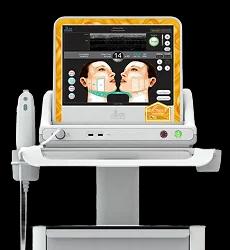
- Treatment
- Ulthera (Ultherapy)
- Device / product
- Ulthera by Merz (USA), high-intensity focused ultrasound (HIFU)
- Area
- Face, jawline and the area under the chin
- Performed by
- Dr. Park Hyungkwon, board-certified dermatologist
- Where
- LUNN Dermatology Clinic, 5F, 822 Seolleung-ro, Cheongdam, Seoul
What does Ulthera actually do beneath the skin?
Ulthera is a high-intensity focused ultrasound (HIFU) device made by Merz in the USA. Instead of warming the whole surface, it concentrates ultrasound energy into small, precise points at a chosen depth. Each point becomes a tiny zone of heat, and the tissue around it responds over the following months by contracting and building new collagen.
What sets Ulthera apart from many skin treatments is how deep it can reach. The face is built in layers: the skin surface, the dermis where collagen lives, the fat beneath it, and the SMAS, a fibrous layer that supports the cheeks and jawline. When the SMAS loosens, the lower face tends to move down as a block. Ulthera is aimed at that structural layer, which is why it is usually discussed when sagging, rather than texture, is the main concern.
Why does LUNN use all three depths: 1.5, 3.0 and 4.5 mm?
Ulthera works at fixed depths, and each depth reaches a different layer. At LUNN in Cheongdam, Dr. Park uses all three in one plan rather than relying on a single setting, so the treatment covers the face from the upper skin down to the SMAS.
A common reason people feel let down after a lifting session is a mismatch between depth and problem. If only the shallow depth is used, the surface may change while the support underneath does not. Combining the three depths is meant to close that gap.
- 4.5 mm: the deepest setting, and the only one of the three that reaches the SMAS. This is the depth used for structural sagging along the jaw and lower cheeks.
- 3.0 mm: works in the deeper dermis, adding support to the layer that gives skin its firmness.
- 1.5 mm: works close to the surface, where it can help skin texture. On its own, it does not reach the SMAS.
How does Dr. Park design the shot count for each area?
There is no single shot count that suits every face. Before treatment, Dr. Park assesses the thickness of the SMAS and how far, and where, the tissue has descended, by looking at your face and by touch. He then divides the face into areas such as the jawline, the lower cheeks, the area under the chin and the sides of the face, and decides the depth and the number of lines for each one.
Two people of the same age can receive quite different plans. One may need concentrated work along the jaw with lighter treatment elsewhere; another may need a more even spread. Too few shots in an area that needs support can limit what the SMAS tightening can achieve, while more shots than the tissue needs adds discomfort without a clear reason.
Because LUNN is a single-doctor clinic, the dermatologist who designs the plan is the one holding the handpiece. You can read about his training on the Dr. Park Hyungkwon page.
Who may be a good candidate for Ulthera?
LUNN’s own treatment notes describe the people for whom Ulthera is usually considered first. These are starting points for a conversation, not a diagnosis.
- People who are beginning to notice sagging in the cheeks, jawline or under the chin
- People whose sagging needs stimulation down to the SMAS layer, not only the skin surface
- People who want a lifting approach without surgery
- People in their 40s or older who are trying lifting for the first time
When might another option suit you better than Ulthera?
Ulthera is not the answer to every concern, and part of the consultation is saying so. If the main change is an overall loss of firmness in the dermis rather than a dropped structure, Thermage FLX may fit better. If the concern is limited to fine lines around the eyes or mouth, Sofwave works on selected areas at a shallower depth. If fullness under the chin comes mainly from fat, ONDA acts on the fat layer, which Ulthera is not designed to reduce.
There are also cases where tightening is the wrong direction. A face that has lost volume in the temples or cheeks can look as if it is sagging, and tightening it further can make it look more hollow. Very marked sagging, or drooping eyelids that affect vision, may be better addressed by surgery, because non-surgical devices have limits.
How is discomfort managed during an Ulthera session?
Ulthera delivers heat deep under the skin, and many people feel it as warmth or a brief, sharp sensation near the bone, especially at the deepest setting. Discomfort varies from person to person and from area to area.
At LUNN, gas anesthesia and numbing cream are applied in stages, so comfort support can be adjusted as the session moves across the face. Sleep anesthesia is not recommended for Ulthera at the clinic. Depending on the areas treated, the session takes about 30 to 60 minutes.
Why are cold packs avoided after Ulthera?
It is natural to expect an ice pack after a heat-based treatment. At LUNN, cold packs and ice are deliberately avoided after Ulthera. The collagen response depends on the heat delivered to the tissue, and the clinic’s view is that cooling it away too quickly can weaken that response. If you feel strong discomfort, the right step is to contact the clinic rather than to cool the area on your own.
Aftercare, including the precautions for the first 48 hours, is explained before you leave. The general lifting guidance is:
- Makeup is permitted on the day, but avoid scrubs and peels
- Apply moisturizer and a barrier-repair cream often, as skin may feel dry
- Use sunscreen whenever you go outdoors
- Avoid alcohol and smoking for at least two weeks
- Avoid saunas, steam rooms, swimming and strenuous exercise for at least one week
What are the possible side effects of Ulthera?
Like any energy-based treatment, Ulthera carries possible side effects, and results vary by individual. The clinic’s side-effect notice lists the following.
Dr. Park performs every Ulthera session himself. Depending on skin type, the lifting aftercare guide notes that bruising, swelling or redness may sometimes persist for three to four weeks. If severe pain or an unusual reaction continues, contact or visit the clinic promptly.
- Redness, swelling or bruising at the treated area, which may last three to seven days
- Rarely, a temporary stiffness of the facial muscles that can make expressions feel awkward, which may last two to four weeks
- A risk of burns, blisters or pigmentation
How does Ulthera fit into a short trip to Seoul?
For international visitors, Ulthera is one of the simpler lifting treatments to plan around a trip. It is usually a single session, and the clinic generally suggests repeating it about once a year, or twice six months apart where sagging is more advanced. You may notice slight tightening soon after the session, but textural change usually appears from around three months and continues toward about six months, so the main change happens after you have gone home.
Tell the clinic your departure date when you book, so any redness or swelling has time to settle before you fly. LUNN is at 5F, 822 Seolleung-ro in Cheongdam, Gangnam, about a one- to two-minute walk from Exit 4 of Apgujeong Rodeo Station, and consultations are held in English. To take the next step, message the clinic using the WhatsApp, LINE or KakaoTalk buttons on this page, read how to book from abroad, or see the official Ulthera page on lunnclinic.com.
Frequently asked questions
How many Ulthera sessions will I need?
Many people need one session. The clinic generally suggests about once a year, or two sessions six months apart for more advanced sagging. The exact plan depends on your skin and is set at the consultation.
Does Ulthera hurt?
Discomfort varies by person and area, and the deepest setting is usually felt more strongly. LUNN uses gas anesthesia and numbing cream in stages, and many people find the session tolerable this way. Sleep anesthesia is not recommended for Ulthera.
When will I see a change after Ulthera?
A slight tightening may be felt soon after treatment. Textural change usually appears from around three months and continues toward about six months. Results vary by individual.
Can Ulthera be combined with Thermage FLX or ONDA?
Yes, when more than one layer has changed. Ulthera may address the SMAS while Thermage FLX works on the dermis, or ONDA reduces local fat under the chin. Dr. Park decides whether a combination makes sense, and in what order, after examining you.
Can I fly home soon after Ulthera?
Many visitors plan Ulthera during a short stay because it is usually a single session. Redness, swelling or bruising may last several days, so book it early in your trip if you can, and read our guide to aftercare after you fly home.
Ask LUNN about your skin before you travel
Send your concern, recent treatments and travel dates. The clinic replies in English. +82-2-512-7788 · Mon–Fri 10:30–20:00, Sat 10:00–16:00 (KST).
Related pages
Main website of the clinic: lunnclinic.com